Petro
Grey BeesPetro is a Ukrainian soldier from Khmelnytskyi whose uneasy first visit to Sergey Sergeyich’s home develops into a friendship sustained by practical help and terse wartime messages. He watches the village from a military position, crosses into it despite the danger, and becomes one of the people Sergeyich thinks of as home recedes. His return, after an injury and hospital stay, turns the unanswered message that had seemed to announce his death into a confirmation that he is alive.
Identity and Introduction
Petro identifies himself as being from Khmelnytskyi. Sergeyich recognizes from this and from Petro’s presence that he is in the Ukrainian army. The young soldier’s rifle and camouflage mark the danger surrounding their encounter, but his manner is courteous: he has come to make Sergeyich’s acquaintance after seeing him for more than a year.
Petro explains that he has been observing the village through binoculars. He had wanted to visit sooner, but daylight was dangerous; even coming at night was not permitted, though he considered it less risky. His arrival thus crosses a boundary between watching the village from a distance and meeting one of its residents face to face.
Visits and Acts of Trust
On his first visit, Petro gives Sergeyich an R.G.D.-5 grenade as a gift, explaining that it did not feel right to arrive at someone’s house empty-handed. The gesture is simultaneously hospitable and inseparable from the war: an explosive becomes a token of respect between host and soldier. Much later, Sergeyich discovers that this same grenade has been hidden among the combs in a hive, and recognizes it as the one Petro gave him.
During a later visit, the two drink tea with honey. Sergeyich asks about his mobile phone, which he had left with Petro; Petro returns it charged and supplies a piece of paper bearing his number. He offers this as a way to stay in touch without hanging rags on trees to communicate. Sergeyich values the soldier’s keeping his word, a quality he says matters in the village.
Messages Across the Front
When Sergeyich decides to send a greeting card for March 8 to his wife and daughter, he uses the number Petro left him and texts a single word asking him to come. Petro arrives around midnight, still in camouflage and carrying his rifle. He agrees to buy a stamp and mail the envelope, making a private family connection dependent on a soldier who can cross between communities where postal service is not equally available.
Petro also advises Sergeyich when he considers moving his bees out of the village. He describes a route through Karuselino, then a checkpoint of the Donetsk People's Republic, the zero checkpoint at the line of contact, and the Ukrainian checkpoint beyond it. Later, after a bombardment lasting about four hours, Sergeyich texts Petro to ask whether he is alive. Petro replies with the same word, without the question mark. The exchange is spare, but its form makes survival itself the message.
Friendship Under Observation
The friendship becomes visible to the authorities when Sergeyich is questioned by Ivan Fyodorovich, who knows about the repeated exchanges asking whether Petro is alive. Asked who Petro is, Sergeyich calls him a friend from a neighboring village that is also being shelled. Under questioning about who is firing on that village, Sergeyich answers uncertainly that it is their side, the separatists. His private messages have become legible to an official observer, turning a simple check-in into evidence of a connection across the lines.
Later, Sergeyich notices a missed call from an unfamiliar Russian number, but finds no new message from Petro. He sends the usual question again. When he prepares to return to Little Starhorodivka, he remembers that Petro has not answered the last two or three messages and concludes that he must have been killed. The thought weighs on him as he walks toward the apiary; thinking instead of Pashka makes the walk easier. Petro’s absence is therefore felt not merely as a lost contact but as part of Sergeyich’s anxious imagining of the home and neighbors to which he hopes to return.
Return and Significance
After finding the grenade in the hive, Sergeyich calls Petro and hears only long tones. Some time later, the phone rings. Sergeyich expects a call from Galya, but is stunned to see Petro’s name. He greets him with joy and relief. Petro says that he is back home after being in hospital and is limping. The exchange resolves the uncertainty created by his silence: he has survived, though he has been hurt.
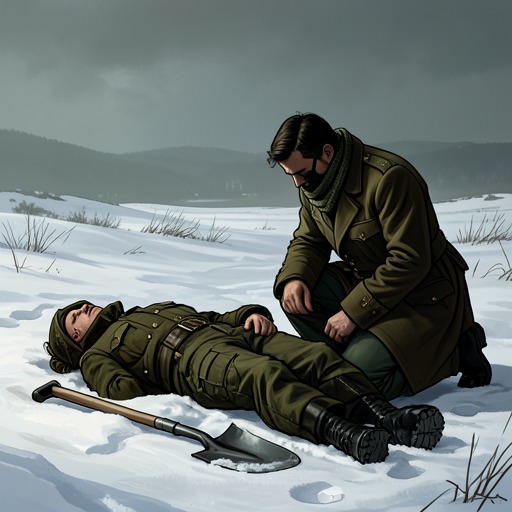
Petro also tells Sergeyich that the dead soldier left in the field has been taken away by the people from Cargo 200 and returned to his family; the man was a volunteer from Dnipro. Sergeyich is relieved that the body has been recovered. He invites Petro to visit when he has time, but Petro laughs that the war is still on. Their friendship offers no escape from that continuing danger. Instead, it persists through gifts, a returned phone, a mailed card, directions across checkpoints, and messages reduced to the question of whether the other is alive. The grenade’s later reappearance in the hive gathers those exchanges into a single object: a gift from a soldier whose fate Sergeyich cannot know until the phone rings.